Access Beyond A Straight Vertical Line
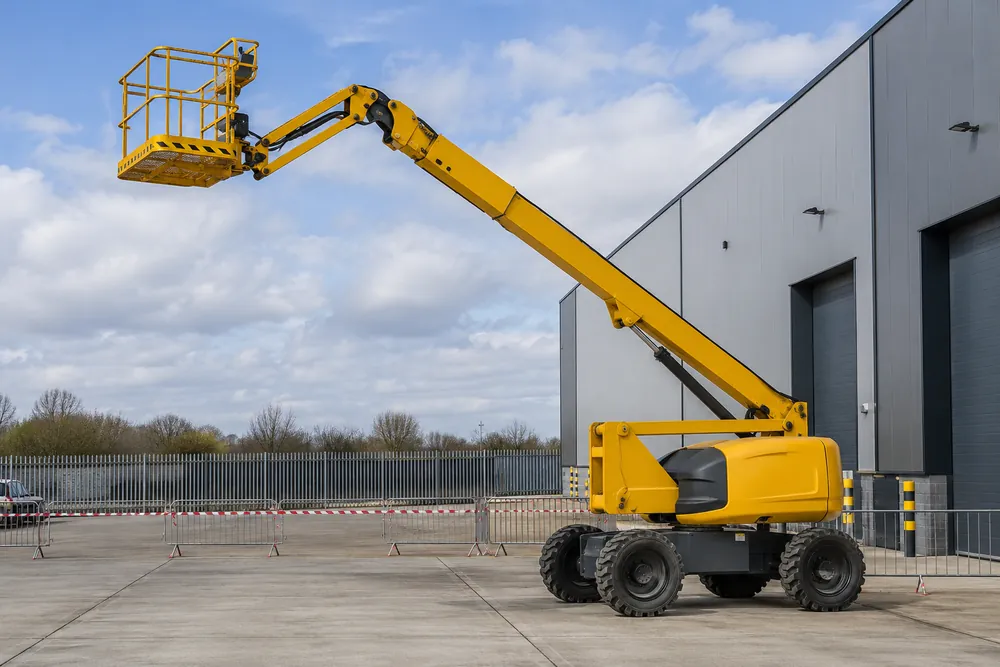
A boom lift carries its platform on an extending arm, allowing the basket to reach away from the machine’s base. This makes it a useful option when work cannot be approached directly from below. Common commercial tasks include façade maintenance, cladding work, external building inspections and access above fixed industrial equipment.
Boom lift and cherry picker are overlapping terms rather than wholly separate categories. This page focuses on self-propelled articulated and telescopic platforms. For a task involving a vehicle-mounted platform or several separate visits, read our cherry picker hire guide and explain the working pattern in your enquiry.
Articulated Or Telescopic Reach
An articulated boom uses jointed sections to negotiate obstructions such as roof projections or fixed plant. A telescopic boom extends in a straighter line and can suit work with a clearer approach. The best option depends on the shape of the space between the base and basket, not just the maximum advertised height.
Check the manufacturer’s working-envelope diagram against the required height and outreach together. Basket capacity and permitted positions vary between machines and operating modes. Include the weight of materials and tools, and ask for the proposed model’s specification when the quotation is prepared.
Room For The Whole Machine
The platform may be above the work area while the base still occupies a busy service road or yard. Allow for chassis width, turning radius, tail swing and any restricted travel positions in the instructions. The person planning the work should consider where the machine will stand at each stage.
Describe overhead cables, pipes, steelwork and the route taken by forklifts or deliveries. If the boom could extend over a traffic route, the work plan must address that interaction. A larger machine may create new restrictions even when it has more than enough reach.
The Hire Process
Begin with a site postcode, photographs of the full elevation and approximate working dimensions. Tell us whether the machine will remain in one place or travel between multiple work positions. Include the task duration and any restrictions on exhaust emissions or noise.
The next stage is to discuss a suitable machine category and identify missing access information. Where uncertainty affects stability or reach, resolve it through a competent site assessment before confirmation. Agree the specification, delivery slot, hire period and operator arrangements in writing.
On delivery, check that the machine matches the agreed specification and that instructions and relevant records are available. Establish the rescue method and the person responsible for ground controls. At completion, follow the agreed collection and off-hire process and keep the confirmation for your records.
Planning For Safe Boom Operation
The risk assessment must consider trapping against overhead structures, falling objects and the possibility of a person being ejected from the basket. Select fall-protection equipment using the task assessment, the platform instructions and competent advice. Never attach a lanyard to a nearby building in place of the designated anchorage.
The Work at Height Regulations 2005 apply to planning and supervision, with PUWER 1998 and LOLER 1998 covering relevant equipment and lifting duties. HSE’s MEWP safety guidance includes ground conditions, rescue and familiarisation. Check weather limits for the exact machine and stop if those limits cannot be maintained.
What A Boom Lift Quote Should Cover
Boom lift hire costs are affected by outreach, power source, platform capacity and contract length. Delivery may need a suitable transporter and enough unloading space. Any operator, restricted-hours attendance or additional site assessment should be identified separately so you can compare the complete scope.
Tell us about fuel or charging arrangements and the likely daily operating pattern. Ask how additional days, collection delays and damage provisions are handled. A written quotation should describe the actual equipment being proposed, because a different operating envelope can materially change whether the job is achievable.
Boom Lift Hire Questions
What Is The Difference Between A Boom Lift And A Scissor Lift?
A boom lift can position its basket away from the base, while a scissor lift mainly raises its platform vertically. That makes a boom useful for reaching across obstructions or working at a stand-off distance. A scissor can suit clear vertical access with more deck space, subject to its capacity and site conditions.
How Much Outreach Do I Need?
Boom lift outreach should be measured from a usable machine position to the actual point of work. Include setbacks created by barriers, weak ground, canopies or loading bays. Maximum height and maximum outreach may not be available together, so compare both measurements with the proposed machine’s working-envelope diagram before confirming the hire.